Koodeep

  • What Changes for Foreign Employees in Korea in 2026?

    If you work in Korea — or plan to — 2026 brings several changes that may affect your salary, benefits, working hours, and holidays. Some are symbolic, others have very real impacts on your monthly paycheck and work–life balance.

    Here’s a clear breakdown of what foreign employees should know about Korea’s labor-related changes in 2026.

    1. Higher Minimum Wage (and Why It Matters Even If You Earn More)

    From 2026, Korea’s minimum wage increases by 2.9%, rising to 10,320 KRW per hour.

    For a standard full-time schedule (40 hours per week, 209 hours per month), that means:

    • Monthly pay rises from 2,096,270 KRW → 2,156,880 KRW

    Even if you earn well above minimum wage, this matters because several benefits are linked to it, including unemployment benefits and parental leave payments.


    2. Higher Unemployment Benefits

    If you qualify for unemployment benefits (구직급여), payouts increase in 2026.

    Daily amounts:

    • Maximum: 66,000 KRW → 68,100 KRW
    • Minimum: increases automatically to maintain at least 80% of minimum wage

    Monthly benefits (30 days, 8 hours/day):

    • Minimum: 1,925,760 KRW → 1,981,440 KRW
    • Maximum: 1,980,000 KRW → 2,043,000 KRW

    This is notable because the maximum cap is rising for the first time since 2019, reflecting stronger income protection for workers.


    3. Higher Maternity Leave Pay

    For foreign employees who qualify for maternity leave, benefits also increase in 2026.

    How it works in Korea:

    • First 60 days (75 days for multiple births): paid by the employer
    • Remaining period: supported by the government

    Changes in 2026:

    • Maximum monthly benefit: 2.1 million KRW → 2.2 million KRW
    • Minimum monthly benefit: rises to 2,156,880 KRW

    Even employees already receiving maternity benefits will see the higher cap applied from 2026.


    4. Shorter Workweeks? Government Support for “4.5-Day Weeks”

    Starting January 2026, the Korean government will financially support small and medium-sized companies that adopt a 4.5-day workweek.

    Support details:

    • Up to 600,000 KRW per employee
    • If new staff are hired, subsidies can reach 800,000 KRW per month per new hire

    This is part of a broader national goal to reduce average working hours to below the OECD average by 2030.

    For foreign employees, this doesn’t guarantee shorter hours — but it signals a strong policy direction toward better work–life balance.


    5. “Workers’ Day” Becomes “Labor Day”

    From 2026, Workers’ Day (May 1) will officially be renamed Labor Day.

    Why this matters:

    • The change reflects a shift toward a more worker-centered and value-neutral understanding of labor
    • It aligns Korea more closely with international terminology

    Practically, it remains a paid day off for most employees — but the renaming reflects changing attitudes toward work and labor rights.


    6. Constitution Day May Become a Public Holiday Again

    July 17 (Constitution Day) may return as an official public holiday after 18 years.

    Background:

    • It was removed in 2008 when the five-day workweek was introduced
    • It is the only national foundation day not currently a public holiday
    • A bill to restore it has already passed committee review

    If finalized:

    • Total public holidays + weekends in 2026 increase from 118 days to 119 days

    For employees used to tight schedules, even one extra public holiday can make a noticeable difference.


    7. More Days Off Overall in 2026

    As it stands:

    • 70 official holidays in 2026
    • 118 total days off including weekends
    • 119 days if Constitution Day is reinstated

    For foreign workers used to fewer public holidays, Korea’s calendar may feel surprisingly generous — especially when combined with annual paid leave.


    What This Means for Foreign Employees

    Not every change directly affects your contract, but taken together, 2026 shows a clear direction:

    • Stronger income protection
    • Gradual reduction of working hours
    • More emphasis on work–life balance
    • Symbolic and legal recognition of labor rights

    If you work in Korea long-term, these changes are worth paying attention to — especially when negotiating contracts, planning family leave, or comparing work cultures across countries.
  • Year-End Tax Settlement in Korea: A Practical Guide for Foreign Employees

    If you work in Korea, you will eventually hear the term “Year-End Tax Settlement” (연말정산). For many foreigners, it sounds complicated — but in reality, it’s a structured process that happens once a year and is largely handled online.

    This guide explains what year-end tax settlement is, when and how to do it, and the special rules and benefits foreign employees should know.


    1. What is Year-End Tax Settlement in Korea?

    Year-end tax settlement is the process of reconciling the income tax you already paid throughout the year with the tax you actually owe.

    In Korea, employers withhold income tax from your salary every month. At the beginning of the following year, the tax office recalculates:

    • your total annual income
    • applicable deductions or tax benefits
    • the final tax amount

    If you paid too much, you get a refund.
    If you paid too little, you pay the difference.

    For most employees, this happens once a year, through their employer.


    2. When does it happen?

    For income earned in 2025, the year-end tax settlement takes place in January–February 2026.

    Typical timeline:

    • Mid-January: Hometax “Simplified Service” opens
    • January–February: Employees submit data to their company
    • By March 10: Final withholding tax return deadline (handled by employer)

    3. How do you do it? (Hometax)

    Most foreign employees use Hometax, the National Tax Service’s online platform.

    The general flow is:

    1. Log in to Hometax
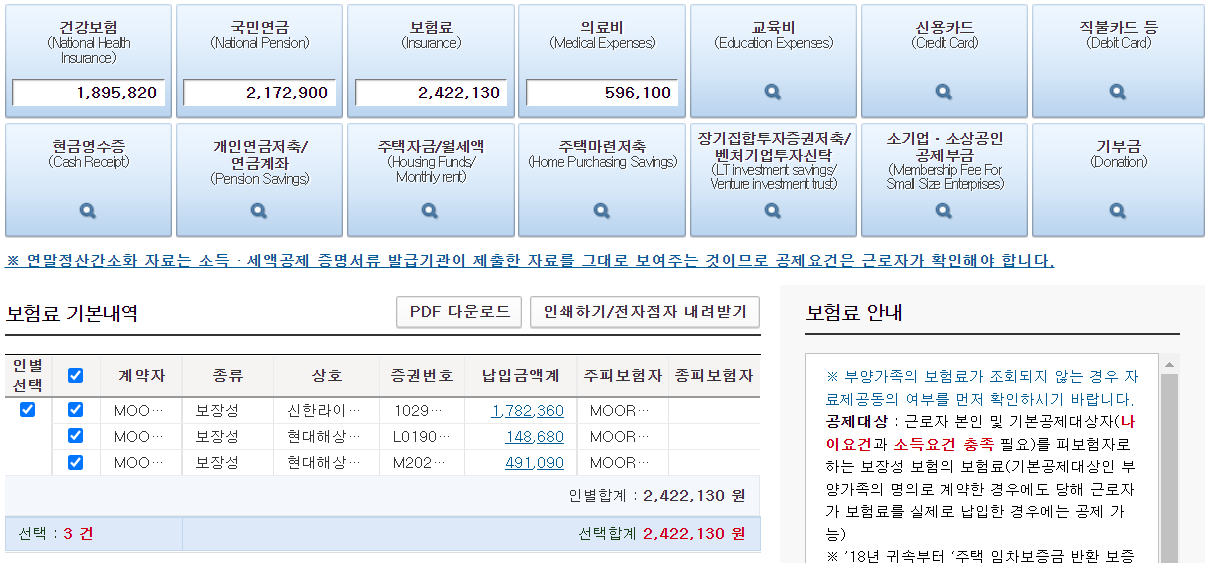
    2. Check your income and deductions via the Simplified Service
    3. Submit documents or consent forms
    4. Your company finalizes the calculation and files the return

    Some companies download employees’ data in bulk (with your consent). Others ask you to download and submit the documents yourself.

    https://centers.ibs.re.kr/img/living_en/overview/tax-file-013.png

    4. Are foreign employees treated the same as Koreans?

    It depends on your tax residency status.

    If you are a Korean tax resident

    You are treated the same as Korean employees for calculation methods.

    You are considered a resident if:

    • you have an address in Korea, or
    • you stayed in Korea 183 days or more in the year

    However, some deductions and special tax rules differ, which is where foreign employees need to pay close attention.


    5. New and important benefits for foreign employees

    (1) Housing savings deduction now available

    From 2025, foreign employees can claim a housing savings deduction (for example, housing subscription savings) if they are the spouse of a non-home-owning household head.

    Previously, foreigners were excluded because they could not be registered as household heads. This rule has now been expanded.

    Conditions:

    • Total annual salary: 70 million KRW or less
    • Tax resident in Korea
    • Spouse of a non-home-owning household head

    Deduction:

    • 40% of the amount paid
    • Up to 3 million KRW per year

    This is a major change for married foreign workers living in Korea.


    (2) Tax reduction for foreign technical professionals

    Foreign employees with specialized qualifications may receive income tax reductions for up to 10 years.

    You may qualify if you:

    • provide technology under an engineering or technology-transfer agreement, or
    • hold a bachelor’s degree or higher in science/engineering with overseas R&D experience

    Benefit:

    • 50% income tax reduction for up to 10 years

    If you work for a designated strategic or specialized company (for materials, parts, or equipment industries), the reduction can be:

    • 70% for the first 3 years

    Highly skilled foreign talent under Korea’s advanced industry talent programs may also apply tax reductions to income received after February 28, 2025.


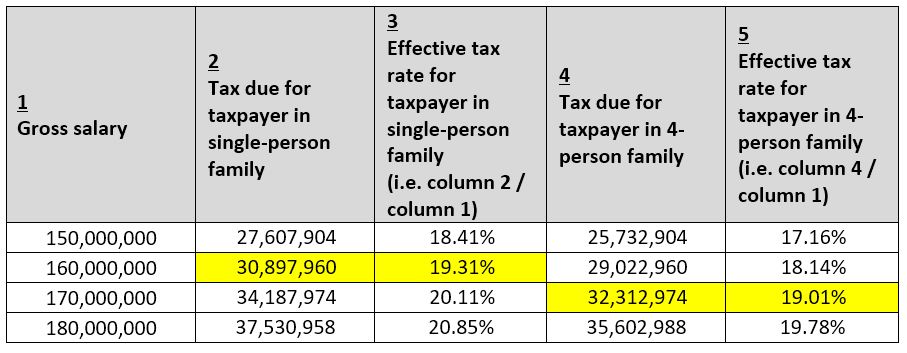
    (3) Optional 19% flat tax for foreign employees

    Foreign employees can choose between:

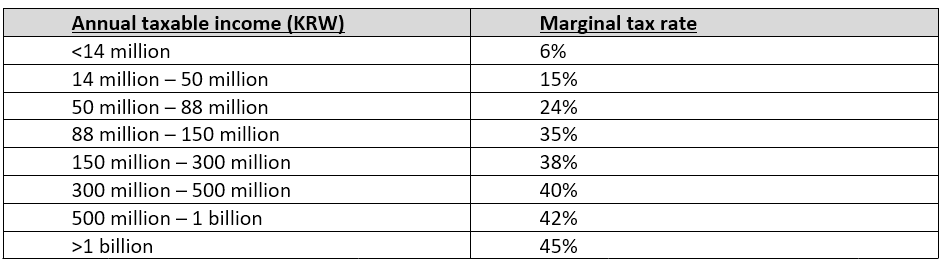
    • the progressive tax rates (6%–45%), or
    • a flat tax rate of 19%, for up to 20 years from their first working year in Korea

    Important points:

    • You must choose one — you cannot mix them
    • If you choose the flat tax, no deductions or tax credits apply
    • Not available if you work for a company in which you own 30% or more shares

    This option can be attractive for high-income earners who do not rely on deductions.


    (4) Income tax exemption for foreign language teachers

    Some foreign teachers may be fully exempt from income tax under tax treaties.

    If:

    • Korea has a tax treaty with your home country, and
    • the treaty includes a teacher or professor exemption clause,

    then income from teaching or research may be exempt for a certain period.

    Treaty rules vary by country, so this must be checked individually.

    https://media.licdn.com/dms/image/v2/D5612AQGXy2zMAtGSRg/article-inline_image-shrink_1000_1488/article-inline_image-shrink_1000_1488/0/1701245091431?e=2147483647&t=oneJkB6chwud5-PhN4o5LakAqEXF9xLtxVuMIrxEjk0&v=beta
    https://media.licdn.com/dms/image/v2/D5612AQGkPvmWl-iaCA/article-inline_image-shrink_1000_1488/article-inline_image-shrink_1000_1488/0/1701245066097?e=2147483647&t=MCA_Kh8SLUDLDurf2G6kyxdNBCxsgNrr49It8DWWBvc&v=beta

    6. What if you are a non-resident?

    Even if you are not a Korean tax resident, you must still settle Korean-source employment income.

    However:

    • Most deductions are not available
    • Family-related deductions and special credits usually do not apply

    In these cases, settlement is simpler but less favorable.


    7. Practical tips for foreign employees

    • Do not assume your company will automatically choose the best tax option for you
    • Compare flat tax vs. progressive tax carefully
    • Check whether you qualify for technical expert reductions
    • Married employees should review housing deductions starting this year
    • Keep records, even if you use the Simplified Service

    The National Tax Service also provides:


    Final thoughts

    Year-end tax settlement in Korea is not just a formality — it’s a chance to recover overpaid taxes or reduce your tax burden, especially if you are a foreign employee with special eligibility.

    The key is understanding which rules apply to you and making informed choices — particularly when it comes to flat tax options and special reductions.

  • The Best Restaurants from Culinary Class Wars in Seoul: Where the White Spoon Chefs Actually Cook

    Netflix’s Culinary Class Wars brings together elite “White Spoon” chefs and rising challengers, showing how creative and competitive Korean cuisine has become. Naturally, many viewers ask:

    Where do these chefs actually cook — and can you eat there?

    Here is a practical guide to the main White Spoon chefs featured on the show, what their restaurants are like, and how much you can expect to spend if you’re planning a special meal in Seoul.


    1. Chef Jun Lee — Soigné (Michelin Two-Star)

    Location: Sinsa-dong, Gangnam
    Michelin: 2 Stars
    Price: Lunch mid-200,000 KRW / Dinner high-300,000 KRW

    Soigné is one of Korea’s most respected fine-dining destinations. Chef Jun Lee builds tasting menus around seasonality and storytelling, creating courses that feel thoughtful and precise. It is considered one of the top fine-dining experiences in the country — but booking requires serious advance planning.


    2. Chef Son Jong-won — Eatanic Garden & L’Amant Secret

    Eatanic Garden (Chosun Palace Hotel, Gangnam)

    Michelin: 1 Star
    Price: Lunch mid-200,000 KRW / Dinner high-300,000 KRW

    A polished, elegant hotel restaurant with refined plates and a luxurious atmosphere. Ideal for travelers looking for a formal dining experience with impressive presentation.

    L’Amant Secret (Hoehyeon / Myeongdong area)

    Michelin: 1 Star
    Price: roughly mid-100,000 to high-200,000 KRW

    A little more approachable in price while still offering sophisticated multi-course menus. A great way to experience Chef Son’s culinary style without the highest tier hotel pricing.


    3. Chef Kim Hee-eun — Soul (Michelin One-Star)

    Location: Haebangchon, Yongsan
    Michelin: 1 Star
    Price: Lunch high-100,000 KRW / Dinner high-200,000 KRW

    Soul helped transform Haebangchon into a serious dining neighborhood. The restaurant reinterprets Korean ingredients in modern, beautifully plated courses. It’s an excellent choice if you want to experience contemporary Korean cuisine rooted in local produce.


    4. Chef Kim Sung-woon — Table For Four

    Location: Hannam-dong
    Michelin: 1 Star
    Price: Lunch mid-100,000 KRW / Dinner mid-200,000 KRW

    Table For Four blends comfort and refinement. The dishes show careful technique while remaining warm and approachable. Because the restaurant is popular and gained even more attention from the show, reservations disappear fast — plan ahead.


    5. Chef Jung Ho-young — Kaden

    Location: Yeonhui-dong
    Price: typically 50,000–150,000 KRW per person

    Kaden is more casual than many fine-dining tasting rooms, which is exactly why people love it. Even before the show, long waits were common. Now, demand is even stronger. Expect satisfying, well-crafted dishes at a friendlier price point than Michelin tasting menus.


    6. Chef Sam Kim — Multiple Italian Restaurants

    Restaurants:
    • Trattoria Sam Kim (Gangnam) — around mid-100,000 KRW
    • Osteria Sam Kim (Mapo) — usually under 100,000 KRW

    Sam Kim is widely known for approachable, flavorful Italian cooking. His restaurants range from casual pasta-friendly spots to more refined courses, making them great options for anyone wanting chef-driven cuisine without ultra-luxury pricing or formality.


    Final Thoughts

    Culinary Class Wars showcases just how diverse Korean dining has become — from Michelin-level tasting menus to creative, accessible restaurants shaped by passionate chefs.

    If you’re planning a food trip to Seoul:

    1. Reserve early (some places book out months in advance).
    2. Consider weekday lunches if dinners are unavailable.
    3. Check price ranges beforehand — tasting menus can run long and feel like an experience rather than a quick meal.

  • Public Holidays in Korea in 2026: What Travelers and Foreign Residents Should Know

    Korea’s public holidays are more than days off — they shape travel plans, working schedules, family gatherings, and even how busy (or empty) the city feels. If you’re living in Korea or planning a trip in 2026, knowing the holiday calendar can help you avoid surprises and even enjoy some bonus long weekends.

    Below is a simple guide to the major Korean holidays in 2026, along with a few travel tips you’ll want to remember.


    1. Lunar New Year (Seollal): February 16–18

    Total break with weekend: February 14–18 (5 days)
    Even longer if you use vacation on Feb 19–20: February 14–22 (9 days)

    Seollal is one of the most important family holidays in Korea. People travel to their hometowns, bow to elders, eat traditional food, and spend time together.

    Important for travelers:
    On the main holiday day, many restaurants, cafés, and small shops close, especially outside tourist zones. Intercity traffic is also extremely heavy.

    If you travel, book trains and buses early — and expect many places to feel quiet.


    2. March 1st Movement Day (Sunday → substitute on March 2)

    March 1st falls on a Sunday, so March 2nd becomes a substitute holiday.
    A quiet, reflective national day — and a convenient extra day off.


    3. Children’s Day: May 5 (Tuesday)

    With a day of leave on May 4, many families create a four-day weekend. Parks, zoos, theme parks, and museums get busy, and travel sites often run promotions.

    Great for family outings — but expect crowds everywhere you go.


    4. Buddha’s Birthday: May 24 (Sunday → substitute on May 25)

    Temples across Korea light colorful lanterns, creating some of the most beautiful spring scenery of the year. Because the actual holiday falls on Sunday, May 25 becomes the substitute holiday.

    If you like cultural experiences, temple visits during this period are unforgettable.


    5. Local Election Day: June 3 (Wednesday)

    Election Day is an official day off for many workplaces. Some businesses remain open, so daily life doesn’t change much — but it’s good to know why schools and offices may be closed.


    6. Liberation Day: August 15 (Saturday → substitute on August 17)

    August brings Korea’s Independence Day. Since the holiday falls on a Saturday, August 17 becomes a substitute holiday, creating another summer long weekend.

    Expect busy highways and packed beaches.


    7. Chuseok (Korean Thanksgiving): September 24–27

    Chuseok is the other major family holiday, similar in importance to Seollal.

    Travel tip:
    On the main Chuseok day, many restaurants, cafés, markets, and even some attractions close — especially outside the big cities. Transportation fills up weeks in advance.

    But if you stay in Seoul, the city can feel pleasantly empty.


    8. National Foundation Day & Hangeul Day (with substitute holiday)

    October brings two meaningful cultural holidays:

    • October 3 — National Foundation Day (개천절)
    • October 9 — Hangeul Day (한글날)

    Because National Foundation Day falls on a Saturday, October 5 becomes a substitute holiday, creating extra long-weekend potential.


    9. Months with no holidays

    Some months in Korea feel long simply because there are no national holidays:

    • April
    • July
    • November

    If you work full-time, these months are usually when vacation requests increase.


    10. Holidays still under discussion

    As of now, two items remain not fully confirmed for 2026:

    • Possible reinstatement of Constitution Day (July 17)
    • Whether December 3 (National Sovereignty Day) becomes official

    Both are still being discussed rather than finalized.


    Travel Advice: Holiday closures foreigners should remember

    For visitors, the biggest surprises happen during Seollal and Chuseok.

    On the main holiday days:

    • Many local restaurants and cafés close
    • A lot of family-run shops close for several days
    • Transportation becomes extremely busy

    If you plan to travel during these periods:

    1. Book trains and buses early
    2. Expect fewer dining options outside tourist areas
    3. Consider staying in big cities — where chains and hotel areas remain open

    Planning ahead keeps the holidays stress-free.

  • Running in Seoul? Why Namsan Is Perfect — and Why You Should Use the Namsan Runner Shower Room

    If you’re visiting Seoul and want to experience the city the way locals do, try going for a run — and there is no better place than Namsan. The mountain rises right in the middle of the city, offering shaded paths, steady climbs, and sweeping skyline views around the famous N Seoul Tower.

    But here’s what makes Namsan especially runner-friendly:
    Seoul operates a dedicated Namsan Runner Shower Room — clean, safe, and completely free. It turns Namsan into one of the most convenient urban running spots anywhere in Asia.


    1. What is the Namsan Runner Shower Room?

    The Namsan Runner Shower Room is a public facility designed specifically for runners who start or finish their workout on Namsan.

    • Name: Namsan Runner Shower Room
    • Location: Seoul Jungbu Park & Leisure Center, 1st floor
      (중구 삼일대로 231 — “남산 러너샤워장”)
    • Hours: 6:30 a.m. – 10:00 p.m., every day
    • Price: Completely free

    Think of it as a runner’s base camp: come in, change, run the mountain, shower, and continue your day exploring Seoul.


    2. What’s inside?

    The facility is simple but thoughtfully equipped:

    • Free lockers for storing your belongings
    • Soap and hair dryers provided
    • Staff present during operating hours, which makes the space feel safe and monitored

    What you still need to bring yourself:

    • Shampoo or face wash as you need
    • Your own towel
    • Any personal toiletries

    It’s practical, clean, and designed with frequent runners in mind — both locals and visitors.


    3. How to enter: QR access via Naver

    Access is controlled for safety. To enter, you:

    1. Open the Naver app
    2. Generate the entrance QR pass
    3. Scan it at the door

    If you don’t use Naver often, set it up in advance — it only takes a minute, and the instructions at the entrance are clear.

    Staff can also guide with basic English you if you’re unsure.


    4. Why runners love Namsan

    Namsan offers a running experience you don’t find in most big cities:

    • Gradual uphill routes perfect for training
    • Forested paths shaded year-round
    • Multiple route options depending on fitness level
    • Iconic views of Seoul at various lookout points

    You can run early in the morning, shower, and be ready for coffee or sightseeing within minutes — all without returning to your hotel.


    5. Tips for first-time Namsan runners

    • Go early or late afternoon for cooler temperatures during Summer
    • Bring water, especially on longer loops
    • Expect climbs — this is hill training, not flat jogging
    • Respect quiet areas, since locals also walk and exercise here

    And don’t worry — you’ll see many Koreans walking, jogging, and training. Namsan is part of the city’s everyday rhythm.


    Final thoughts

    For travelers who love running, Namsan is the perfect mix of nature, city scenery, and challenge. And with the Namsan Runner Shower Room offering free lockers and showers, it’s easier than ever to combine training with sightseeing.

    If you plan to run Namsan during your trip, tell me when you’re going and where you’re staying — I can suggest the best trail routes and nearby cafés to recover afterward.

  • How to See a Doctor in Korea Without Speaking Korean: A Practical Guide for Foreigners

    1. Why this guide matters — cold weather, colds, and unexpected visits

      As the weather gets colder in Korea, more people find themselves dealing with colds, sore throats, allergies, and seasonal flu. For locals, visiting a neighborhood clinic is simple. But for foreigners, the health system can feel unfamiliar — different language, new procedures, unfamiliar signs.

      So a common question appears:

      How do I see a doctor in Korea if I don’t speak Korean?

      The reassuring part is this: Korea’s healthcare system is fast, organized, and surprisingly easy to use — even with limited Korean. This guide walks you through exactly what to do.


      1. Where to go first: clinics vs hospitals

      In Korea, you usually start with a local clinic (의원 / uui-won) instead of a big hospital.

      • Local clinics
        Best for everyday illnesses: colds, flu, infections, allergies, stomach problems, minor injuries. They are quick and inexpensive.
      • General hospitals (종합병원 / jong-hap-byeong-won)
        Used when you need more specialized treatment or tests.
      • University or national hospitals
        Reserved for complex or serious cases. Expect longer waits and appointments.

      When unsure, start with a clinic. If something requires advanced care, the clinic doctor will refer you.


      1. How to find an English-friendly clinic

      You don’t have to guess — there are reliable ways to search:

      • Google Maps, Naver Maps, or Kakao Maps (search “Englich speaking clinic” or “외국인 병원”)
      • Search “international clinic” in your city
      • Ask your hotel, university office, or employer — they often know English-friendly doctors
      • Larger hospitals often run International Patient Centers specifically for foreigners

      And here is a practical tip:
      areas with many foreigners — such as Hongdae, Itaewon and Gangnam — tend to have clinics more accustomed to English-speaking patients, making them good starting points if you feel unsure.

      If communication becomes difficult, most clinics are comfortable using translation apps.


      1. What to bring

      Bring these if you can:

      • Passport or Alien Registration Card (ARC)
      • Korean National Health Insurance card, if you have coverage
      • A list or photos of your medications
      • Allergy information

      Even without insurance, treatment is typically far cheaper than in many Western countries — you’ll simply pay the full cost.


      1. What happens inside the clinic: step by step

      A typical visit looks like this:

      1. Check in at the reception desk
      2. Fill out a short form about symptoms and your information
      3. Wait 5–20 minutes
      4. Meet the doctor
      5. Pay at the front desk
      6. Take your prescription to the pharmacy next door

      Most clinics have pharmacies right nearby, often in the same building.


      1. Useful Korean phrases for the doctor

      Short phrases help a lot:

      • 감기 걸린 것 같아요. (gam-gi geol-lin geot ga-ta-yo)
        I think I have a cold.
      • 알레르기가 있어요. (al-le-reu-gi-ga i-sseo-yo)
        I have allergies.
      • 열이 있어요. (yeo-ri i-sseo-yo)
        I have a fever.
      • 여기가 아파요. (yeo-gi-ga a-pa-yo)
        This part hurts.
      • 번역 앱 사용해도 될까요? (beon-yeok app sa-yong-hae-do doel-kka-yo?)
        Can I use a translation app?

      Doctors are very used to translation tools — feel free to ask.


      1. Prescriptions and pharmacies

      After the consultation, you will receive a printed prescription. Bring it to the pharmacy.

      In Korea, pharmacies often pack medication into clearly labeled doses (morning, afternoon, evening), making it easy to follow instructions even without English.

      If needed, ask:

      • 영어 설명 가능해요? (yeong-eo seol-myeong ga-neung-hae-yo?)
        Can you explain in English?

      Many pharmacists will provide at least simple guidance in English.


      1. Costs: what to expect

      With National Health Insurance:

      • 5,000–20,000 KRW for most clinic visits, plus medication

      Without insurance:

      • Usually 30,000–70,000 KRW, depending on treatment and tests

      Overall, Korean healthcare remains relatively affordable compared with many countries.


      1. Emergency situations

      Go straight to the ER (응급실 / eung-geup-sil) if you experience:

      • Severe trouble breathing
      • High persistent fever
      • Chest pain
      • Serious injury

      Emergency numbers in Korea:

      • 112 — police
      • 119 — ambulance / fire

      You can ask for English assistance through emergency services.


      1. Final thoughts: don’t let language stop you

      Seeing a doctor in Korea without speaking Korean may feel stressful, but the reality is encouraging: clinics are efficient, staff are familiar with foreign patients, and translation tools bridge most communication gaps.

      The key message is simple:

      If you feel unwell, don’t hesitate to go. Help is accessible — even without Korean.

      If you’d like, I can now create a follow-up post such as:

      • “How to buy medicine at a Korean pharmacy”
      • “How Korean hospitals and referrals work”
    1. Do Koreans Still Eat Dogs? Understanding the Past, Present, and Future of Dog Meat in Korea

      “Do Koreans still eat dogs?”
      This question appears often online, and the answer requires context. Yes — dog meat existed historically in Korea, but modern Korean society has changed dramatically. Today, dog consumption has declined sharply, especially among younger generations, and new laws are rapidly bringing the practice to an official end.

      To understand how we got here, it’s helpful to look at three phases: the past, the social changes since the 1980s, and what is happening now with Korea’s dog-meat ban.


      1. Why did dog-eating become part of Korean culture in the past?

      Historically, Korea was an agricultural society that experienced frequent food shortages. Meat was not always easy to access, and refrigeration technology did not exist.

      In this context, dog meat became:

      • A supplementary protein source during scarce seasons
      • A dish associated with strength, stamina, and “restoring energy” especially during hot and humid summer seasons
      • A product raised locally in rural areas

      Unlike in some Western cultures, dogs historically had different roles — working animals, guards, and livestock — and not only as household companions.

      So yes, in earlier decades, dog meat existed as part of daily survival culture in certain regions, particularly among older male communities.


      2. After the 1980s, everything changed: food abundance and the rise of pets

      From the 1980s onward, Korea underwent rapid economic growth. At the same time, society changed in three fundamental ways.

      First, other meats became widely available — pork, chicken, and beef became affordable everyday foods. There was simply no practical need for dog meat anymore.

      Second, urbanization shifted social life. More people lived in apartments, fewer lived on farms, and dogs increasingly moved indoors — as companions, not livestock.

      Third, pet culture spread quickly. Veterinarians, pet cafés, grooming shops, and adoption awareness grew. Young people now speak of dogs as “family members.”

      As a result, consumption declined steadily. Surveys consistently show:

      • Younger Koreans rarely — or never — eat dog meat
      • Many view it as outdated, uncomfortable, or ethically unacceptable

      In modern Korea, especially among people in their 20s and 30s, dogs are overwhelmingly seen as pets, companions, and emotional partners — not food.

      In Seoul, dedicated dog parks and pet-friendly spaces are becoming common — a sign that companion-animal culture has truly taken root in modern Korea.

      3. The dog-meat ban: how fast the industry is disappearing today

      The final phase is happening right now.

      Korea enacted the Special Act on Ending Dog Meat Consumption (“개식용종식법”), designed to phase out breeding, slaughter, and distribution of dogs for food. Since the law began, closures have accelerated far faster than expected.

      According to government data:

      • Since implementation, 78% of dog-breeding farms have already closed by the end of 2025
      • Over 390,000 dogs formerly raised for meat are no longer in farms
      • Farms originally scheduled to close in 2026–2027 shut down early because of incentives and shifting public attitudes

      The government is:

      • Providing compensation and transition loans
      • Helping farmers move to other livestock businesses
      • Preventing farms from restarting operations

      If current trends continue, authorities expect complete termination by February 2027 — ahead of schedule.

      In short: the industry is vanishing rapidly, not expanding.


      Final answer: So… do Koreans still eat dogs?

      Here is the clearest way to summarize:

      • Historically: yes, dog meat existed, influenced by scarcity and tradition.
      • Since the 1980s: consumption declined sharply as Korea modernized, pet culture spread, and alternative foods became common.
      • Today: the practice is nearly gone, especially among younger generations, and new laws are actively bringing it to a rapid end.

      Most Koreans — especially younger people — now see dogs as companions, family members, and pets, not food. The remaining businesses tied to dog meat are closing, supported by transition programs and driven by changing social values.

      So, when someone asks, “Do Koreans still eat dogs?” the honest answer is:

      Korea once had a dog-eating tradition, but modern Korean society has largely moved past it — and the practice is now disappearing for good.

    2. K-Body Scrub: Why Koreans Love Ttaemili and Where Travelers Can Try It

      K-pop and Korean dramas have already taken the world by storm — but lately, another everyday ritual has quietly entered the spotlight: ttaemili, the Korean tradition of body scrubbing. Pop culture helped push it into view.

      In K-Pop Demon Hunters, the K Pop group Huntrix relaxes inside a Korean jjimjilbang, soaking in hot baths and experiencing a professional scrub. For many viewers, it was their first introduction to public bath culture in Korea — and to a scrubbing ritual that looks intense, yet strangely refreshing.

      Ttaemili is more than a spa treatment. For many Koreans, it is about cleansing deeply, relaxing fully, and symbolically wiping away fatigue — even “scrubbing off the old year” around New Year’s Day. If you are curious about how it works and where you can try it, this guide walks you through everything.


      1. What exactly is ttaemili?

      Ttaemili refers to the deep exfoliating scrub, often performed by a trained professional called a sesin-sa (세신사).

      You first soak in warm baths or saunas so your skin softens. Then the sesin-sa uses a rough textured towel to scrub your entire body. Layers of dead skin roll off, leaving the skin smooth, light, and incredibly clean.

      It can feel strong — but most people say the result is worth it.


      2. Where can travelers experience ttaemili?

      You don’t need a luxury spa. In Korea, ttaemili is part of everyday life, and you can find it in:

      • Public bathhouses (목욕탕)
      • Jjimjilbangs (찜질방) — large bath and sauna complexes
      • Private one-person scrub shops, many designed with foreign visitors in mind

      Almost every bath facility has a scrubbing section with professional sesin-sa (세신사), typically women for women and men for men. The service usually costs around 30,000–60,000 KRW, depending on location and what is included (body scrub only, or body plus light massage, etc.).

      Compared with Western spa exfoliation treatments, it is surprisingly affordable — and much more traditional.

      Because demand from foreign visitors has surged, some hotels now even offer scrub packages.


      3. Helpful Korean phrases to use

      You can manage with English in most places, but a few Korean phrases make everything easier — and friendlier.

      • “때 밀고 싶어요.” (ttae mil-go si-peo-yo)
        I would like to get a body scrub.
      • “덜 아프게 해주세요.” (deol a-peu-ge hae-ju-se-yo)
        Please do it more gently.
      • “세게 해주세요.” (se-ge hae-ju-se-yo)
        Please do it stronger.
      • “얼마예요?” (eol-ma-ye-yo)
        How much is it?

      Even saying one sentence in Korean usually brings a smile — and helps you get exactly the kind of scrub you want.


      4. The famous ttaemili towel

      If you’d rather try self-scrubbing, Koreans use a special towel called 때수건 (ttaemili towel). It is rougher than normal cloth, which is why it works so well after a long soak.

      You can buy it easily:

      • Daiso (the popular discount store found everywhere)
      • Traditional markets
      • Household goods shops and some convenience stores

      They are cheap, and many tourists buy multiple towels as gifts because they feel “so uniquely Korean” with their vivid colors.


      5. What does ttaemili mean to Koreans?

      Beyond exfoliation, ttaemili is tied to family memories and care. Parents scrubbed children, grandparents scrubbed grandchildren — the bathhouse was a place to talk, relax, and bond.

      There is also symbolism. Many families still visit the bathhouse around January 1st to scrub themselves clean, as if removing the past year and welcoming the new one with a refreshed body and spirit.

      Ttaemili is everyday, practical — and quietly meaningful.


      6. A rising global trend

      With dramas, films, and social media showing jjimjilbang scenes, curiosity exploded. Shops report foreign travelers buying dozens of towels at once. Hotels and boutique scrub studios are adding specialized scrub programs because most of their customers are now international.

      What used to be an ordinary weekend ritual is now joining K-food and K-beauty as another global curiosity: K-scrub.


      7. Is ttaemili right for everyone?

      If your skin is extremely sensitive or you have medical conditions, ask first or choose a very gentle scrub. Otherwise, most visitors simply adjust the pressure — lighter or stronger — and enjoy the feeling of deep cleansing.

      The rule is simple: soak long enough, relax, and let the sesin-sa do their job.


      Final thoughts

      Ttaemili may look unusual at first, but it reveals something beautiful about Korean culture: care, renewal, and the comfort of shared rituals. Whether you experience it in a neighborhood bathhouse, a jjimjilbang, or a dedicated scrub studio, it offers one of the most authentic ways to experience daily life in Korea.

    3. KORAIL PASS PLUS vs. Climate Companion Card: Which One Should Travelers Choose?

      Korea has introduced a new foreign-visitor rail product called KORAIL PASS PLUS. It combines unlimited long-distance train travel with the convenience of a rechargeable transit card you can tap on subways, buses, taxis, and even at convenience stores.

      At the same time, travelers hear a lot about Seoul’s Climate Card, which offers unlimited local transportation inside the city. So which one should you choose? And when does the rail pass truly become cheaper than simply buying KTX tickets as you go?


      1. What is KORAIL PASS PLUS?

      KORAIL PASS PLUS merges two products into one physical IC card:

      • Unlimited rides on KORAIL trains (including KTX) for 2–5 consecutive days
      • A prepaid transit card you can load and use on subways, buses, taxis, and selected shops

      You first buy the regular KORAIL Pass, then pay KRW 8,000 to upgrade to KORAIL PASS PLUS. Pick up the card at kiosks in airports or major KTX stations, load money, and start traveling.

      Adult prices for the rail portion:
      2-day: 131,000 KRW
      3-day: 186,000 KRW
      4-day: 234,000 KRW
      5-day: 275,000 KRW

      It also comes with a traditional taegeuk design, so many travelers keep it as a souvenir.


      2. Does it beat buying normal KTX tickets? Let’s calculate.

      Typical one-way KTX fares (approximate, adult, standard seat):

      • Seoul → Busan: ~59,000 KRW
      • Busan → Daegu (Dongdaegu Stn): ~18,000 KRW
      • Daegu → Gyeongju (Singyeongju Stn): ~13,000 KRW
      • Gyeongju → Seoul: ~47,000 KRW

      Total: about 137,000 KRW

      Compare that to the rail pass:

      • 3-day KORAIL Pass: 186,000 KRW
      • 4-day KORAIL Pass: 234,000 KRW
        (+ 8,000 KRW only if you want the PLUS transit-card upgrade)

      For this itinerary alone, ordinary KTX tickets are actually cheaper.

      So when does the pass start winning?


      3. When does KORAIL PASS PLUS become the better deal?

      Think in terms of total KTX rides, especially long-distance ones.

      For a 3-day trip

      If you expect 5 or more KTX rides, particularly with at least one long stretch like Seoul–Busan,
      KORAIL PASS PLUS can become financially competitive.

      For a 4-day trip

      If your plan involves 7 or more KTX rides,
      the 4-day version generally starts to outperform individual ticket purchases.

      In other words, the more cities you add — and the faster you move — the more the pass makes sense.


      4. Where does the Climate Card fit in?

      The Climate Card focuses on unlimited local transit in and around Seoul and metropolitan area:

      • Unlimited subway rides
      • Unlimited bus rides
      • Predictable daily transportation costs

      (If you want a deeper walkthrough of how the Climate Card works, how to buy it, and whether it’s worth it for short-term visitors, take a look at our detailed guide here: How to Use Seoul’s Climate Card (기후동행카드)as a Foreigner: A Practical Guide for Seoul tourists – Koodeep)

      If your itinerary is mostly palaces, neighborhoods, markets, museums, and cafe hopping inside Seoul, you will likely tap dozens of times per day. In that scenario, the Climate Card is extremely cost-effective.


      5. The honest downside of KORAIL PASS PLUS

      Owning the pass does not guarantee you a seat on every train you want.

      Popular segments — for example:

      • Saturday morning
      • Seoul → Busan
      • Peak travel seasons or holidays

      often sell out early.

      If you issue the pass and try to reserve seats right before departure, it may be difficult. For travelers who have strict schedules, this matters.

      KORAIL PASS PLUS is best when:

      • You have flexibility in departure times
      • You do not insist on peak-hour trains
      • You can travel more often on weekdays than weekends

      If your schedule is tight, sometimes booking a few key KTX tickets in advance (instead of relying only on the pass) is safer.

      You can buy KORAIL PASS PLUS at kiosks in convenience stores at airports or major train stations in Seoul.

      6. Simple decision guide

      Staying mostly in Seoul

      Choose Climate Card.
      Unlimited local rides usually give more value than a rail pass you barely use.

      Traveling across multiple cities quickly

      Choose KORAIL PASS PLUS.
      Unlimited KTX rides are the real advantage, and the card still works on city transit.

      Mixing Seoul sightseeing with only one or two KTX trips

      Consider buying regular KTX tickets + Climate Card.
      That combination can easily be cheaper.


      Final takeaway

      • 3-day itinerary: If you expect 5 or more KTX rides, KORAIL PASS PLUS starts to make sense.
      • 4-day itinerary: If you expect 7 or more KTX rides, the rail pass often becomes the more economical option.

      But if your trip revolves mainly around exploring Seoul’s neighborhoods and attractions, the Climate Card quietly wins by keeping public transportation unlimited and simple.

      Plan your route first, count your inter-city rides, and then choose. That small step often makes the difference between overspending and traveling smarter — which is exactly what Koodeep aims to help with.

    4. Hwacheon Sancheoneo Ice Festival 2026 — Korea’s Winter Playground on a Frozen River

      If you’ve ever wondered what winter in Korea really feels like — not just from city streets but out on a frozen river, surrounded by laughter, bright lights, and steaming grilled fish — the Hwacheon Sancheoneo Ice Festival is where it all comes together. Held every January in Gangwon Province, this festival turns bitter cold into pure fun. Instead of hiding indoors, people bundle up, step onto the ice, and discover how winter becomes a celebration here.

      Below is a traveler-friendly guide to what you can expect — and how to make the most of it.


      1. Festival overview — when, where, and why it’s special
      Every winter, the clear river running through Hwacheon freezes thick enough to become a giant outdoor playground. In 2026, the festival runs from January 10 to February 1, spreading across the Hwacheoncheon river area. The clean water, heavy snow, and naturally cold climate create conditions perfect for ice activities. What makes this festival special is its hands-on nature: instead of just watching performances, you’re encouraged to participate — drill, fish, slide, explore, and eat.
      Traveler tip: Hwacheon is colder than Seoul. Bring thermal socks, hand warmers, and waterproof boots. Arrive early in the morning for lighter crowds and better photos.


      2. Ice fishing — the signature experience (and lunch!)
      Visitors drill small holes into the frozen river and try to catch sancheoneo (mountain trout) swimming below. The anticipation is half the fun — fingers numb from the cold, everyone cheering when a fish finally jumps out of the water. You can participate through on-site registration or pre-booked programs, and it’s suitable for both adults and children. Even better, the fish you catch can be grilled, fried, or made into sashimi right on site.
      Traveler tip: Gloves with good grip help. Ask whether your ticket includes fishing gear rental. If you catch fish, head to the nearby grilling booths — they’ll handle the rest.


      3. More than fishing — sleds, slides, ice sports, and pure winter energy
      All across the festival grounds, activity zones turn the ice into a playground. Kids and adults jump onto traditional sleds, snow tubing hills, ice soccer fields, ice bobsled tracks, and even giant slides like the “Ice Bear Castle.” These aren’t just children’s attractions — you’ll see entire families racing, laughing, and filming videos together.
      Traveler tip: Check the posted age/height signs at each zone. Popular rides can get busy; visit right after opening time or before closing for shorter waits.


      4. Ice sculpture plaza — winter art you can walk through
      Another highlight is the ice sculpture square, where towering blocks of ice become castles, world landmarks, animals, and characters. Under the sunlight (and especially under night lighting), the sculptures glow in surreal colors. It’s one of the most photogenic corners of the festival, and you’ll see plenty of visitors posing with their phones ready.
      Traveler tip: Keep your phone warm inside your pocket between photos — batteries drain fast in sub-zero weather.


      5. Family-friendly spaces, food stalls, and cozy local life
      Hwacheon keeps things welcoming for families: safe play zones, rest areas, and easy-to-find food stalls selling warm soups, snacks, and local specialties. Many families turn the day into a picnic — catching trout, grilling it together, then exploring the snow playgrounds. Souvenir shops also feature regional products, perfect for gifts.
      Traveler tip: Bring wet wipes, tissues, and a small backpack. Outdoor eating is fun, but a bit messy when gloves and sauce get involved.


      6. Nighttime atmosphere — lights, quiet snow, and even night fishing
      When the sun sets, the frozen river transforms again. Festival lights reflect on the ice, children hold small heaters, and in some areas night fishing opens — peaceful, slightly mysterious, and unforgettable. The cold sharpens the senses, but the mood becomes warm and almost festive.
      Traveler tip: Dress in layers and consider renting a portable hand warmer from vendors if available.


      7. Easy packages and shuttle buses from major cities
      For visitors unfamiliar with rural transit, package tours are convenient. Many include round-trip shuttle buses from Seoul, festival admission, fishing tools, and sometimes ride tickets — making the day simple and stress-free. Because the festival is seasonal, services are designed specifically for first-timers.
      Traveler tip: Book earlier on weekends. Weekdays are quieter and often cheaper.


      8. Nearby winter scenery — extend your day trip
      Beyond the festival, Hwacheon offers calm countryside walks and snow-covered landscapes. Nearby spots such as Gugok Falls become beautiful winter viewpoints, giving you time to slow down after the excitement.
      Traveler tip: If you’re renting a car, check road conditions. Mountain roads can be icy after sunset.


      Takeaway

      The Hwacheon Sancheoneo Ice Festival isn’t just about fishing — it’s about discovering how Koreans transform deep winter into play, family time, and shared laughter. With frozen-river adventures, warm food, sparkling sculptures, night lights, and easy shuttle access, it delivers one of Korea’s most memorable seasonal experiences. If you’re visiting Korea in January, bundle up, step onto the ice, and let this unique festival show you how magical winter in Korea can be.